Rooms Built for Exposure
The best mountain room is not the one that makes the weather disappear. It is the one that makes being indoors dependable.
Begin at the threshold
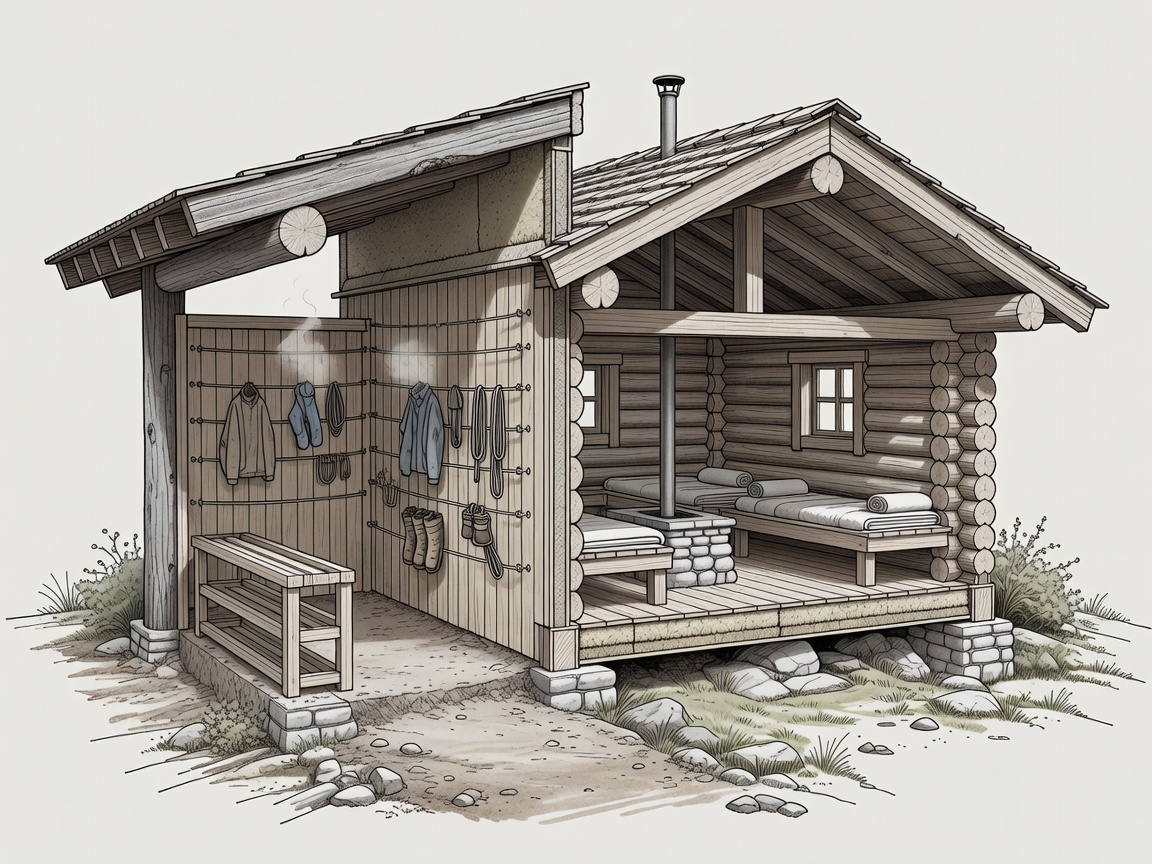
Arrive with wet gloves, a damp pack and boots carrying grit. That is the moment when a station-inspired lodge begins to reveal whether its architecture is more than a visual theme. A useful entrance gives you somewhere to stand, remove layers and contain moisture without opening the sleeping room directly to the wind.
A weather lobby need not be large. Its value lies in sequence: outside, buffer, drying or storage space, then the inhabited room. Ask where equipment goes and whether drying is actively provided. A photograph of a timber bench does not establish that wet clothing will be dry by morning.
Warmth is a system, not a fireplace
A visible stove can be reassuring, but comfort depends on the entire enclosure: insulation, draught control, glazing, ventilation and the distribution of heat. Ask which rooms are heated, whether heating runs overnight and what guests should do if the main system fails. Do not assume that fuel, controls or backup equipment are available for unrestricted guest use.
Ventilation matters especially when several people and their wet equipment share a small volume. Condensation on a window can be a temporary nuisance or a sign that moisture has nowhere useful to go. Guests should follow operating instructions rather than blocking vents to make a room feel warmer. Never improvise indoor heating with camping stoves or equipment intended for outdoor use.
Water changes the meaning of comfort
A remote water supply may depend on storage, pumping, treatment or seasonal conditions. Before booking, establish whether drinking water is supplied, whether taps are potable and whether showers are limited. An attractive bathroom says little about the source or capacity of the system behind it. Bring the drinking water the operator recommends, but avoid inventing your own treatment plan without understanding the actual risk.
Toilets also deserve a straightforward question. Flushing, composting and other systems have different instructions, particularly in cold conditions. Respecting them is part of staying in a small, constrained building. Remote does not necessarily mean basic, but it should mean that service limitations are explained before arrival rather than discovered after dark.
Where do the wet things go?
Before settling in
Locate the drying area, drinking water, exit route and the instructions for heating and ventilation.
Before going to sleep
Check the morning weather information and agree how the group will respond if the planned departure becomes unsuitable.
Before calling it comfortable
Ask whether everyone can sleep, move through the room and use essential facilities without unnecessary difficulty.
A window is not the whole experience
Station imagery often centres on a panoramic window. Yet a convincing overnight room must work when that window shows only cloud. Look for task lighting, a usable table, somewhere to sit without occupying the bed, and the ability to darken the room. In compact accommodation, small practical provisions can matter more than additional floor area.
Noise is another overlooked condition. Wind around external fittings, mechanical ventilation and shared walls may all affect sleep. There is no reason to assume an exposed building is silent. If sound sensitivity, limited mobility or a medical need affects your stay, describe the requirement precisely and request a concrete response from the operator. A general promise of “cosiness” is not an accessibility specification.
Privacy, staffing and the isolated night
The word “private” can mean an exclusive bedroom, sole occupancy of a whole building or simply a privately operated property. These are different arrangements. Confirm whether bathrooms and dining areas are shared, whether staff remain overnight and whether other visitors can enter common spaces. Also establish how help is requested if mobile coverage disappears.
Consider power and communications without turning them into a romantic test. Limited charging may be manageable if disclosed; unreliable emergency communication is a more serious question. Download essential documents in advance, keep a light independent of your phone, and follow the property's battery and electrical safety rules. Your accommodation's isolation should be understood, not performed.
| Visible feature | Useful question | Do not assume |
|---|---|---|
| Glazed lookout | Can it be shaded, ventilated and heated? | That a large view means good sleeping comfort. |
| Boot room | Is there active drying and enough shared capacity? | That wet equipment can go into bedrooms. |
| Compact kitchen | Which appliances, food and drinking water are provided? | That all supplies can be bought nearby. |
| Historic structure | What has been adapted for current use? | That heritage proves modern accessibility. |
Adaptation without theatre
A building influenced by the Sonnblick Observatory or the Sphinx Observatory need not imitate their appearance. The stronger connection may be a compact plan, robust service space and carefully controlled openings. Architectural honesty means explaining what is historic, what is new and why an alteration improves the building's present use.
That same honesty should extend to environmental claims. A small footprint does not automatically mean low impact once transport, heating and supply journeys are considered. Ask for specific practices rather than a broad “off-grid” label. A well-managed conventional service can be more credible than a dramatic sustainability story with no operating detail.
Next: the last kilometres